The Benefits of Modular Refrigeration Design
If you are outgrowing your cold storage space, dealing with refrigeration failures that take your operation offline, or struggling to find a cooling solution that fits your facility’s layout, you might be wondering if there is a better way. There is, and it’s called modular refrigeration design.
Modular refrigeration may not be a new concept, but it’s starting to gain serious traction in the food processing, agriculture, cold chain logistics, and commercial foodservice spaces. The reasons are plenfitful—modular refrigeration is faster to install, easier to maintain, and has excellent efficiency. Let’s learn more about how modular refrigeration works and the benefits it can offer your facility.
What Is Modular Refrigeration?
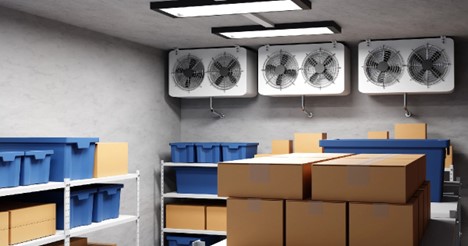
Modular refrigeration refers to a system built from standardized, self-contained units that can be combined, expanded, or reconfigured to meet changing needs. Rather than designing and installing a single large custom refrigeration system, you’re working with individual modules that work together as a cohesive whole.
Think of it like building blocks. Each block does its job independently, but together they create something much larger and more capable. And if your needs change, you can add blocks, swap them out, or reconfigure them without tearing everything apart and starting over.
Flexibility Is the Game Changer
One of the biggest advantages of refrigerated containers is how well it adapts to the reality of running a business. Imagine that you land a new contract and suddenly need twice the cold storage. Or you expand into a new product line that requires a different temperature range. You might even move to a larger facility and need to bring your refrigeration with you.
With a traditional built-in system, any of those scenarios means a significant capital investment and a lot of construction. With a modular system, it often means adding a unit or reconfiguring what you already have. That kind of flexibility has real dollar value, especially for operations that are growing or that experience seasonal fluctuations in their cold storage demands.
Redundancy Protects Your Product
Here’s something that doesn’t get talked about enough with traditional refrigeration systems: when they go down, everything goes down. One compressor failure can put your entire cold storage inventory at risk while you wait for repairs. In industries where product loss is measured in tens of thousands of dollars, that’s an exposure most operators would rather not have.
Modular systems change that equation. Because each module operates independently, a failure in one unit doesn’t automatically affect the others. Your remaining modules continue to hold temperature while the affected unit is serviced. It provides built-in redundancy, and for food processing facilities, pharmaceutical storage, and any operation where cold chain logistics are non-negotiable, that redundancy is worth a great deal.
Easier Maintenance and Faster Repairs
Modular refrigeration systems are also significantly easier to service than large custom-built systems. Because the components are standardized, technicians are already familiar with how they work. Parts are more readily available. And because each module is self-contained, a technician can often isolate and address a problem quickly without needing to take the entire system offline.
Over the life of the system, that translates to less downtime, lower maintenance costs, and a more predictable service experience. And for facility managers who’ve lived through the nightmare of waiting weeks for a custom part on a proprietary system, that predictability is valuable.
Quicker Installation for the Win
Large traditional refrigeration systems require significant construction, including custom fabrication, extensive electrical and mechanical work, and often modifications to the building itself. Modular systems, by contrast, are designed to be installed efficiently. Many modular units arrive largely pre-assembled and can be operational in a fraction of the time a custom system would require.
That faster refrigeration installation timeline means less disruption to your operation during setup, and a shorter gap between investment and return. This matters greatly for facilities that can’t afford extended downtime.
Is Modular Right for Your Facility?
Modular refrigeration is not the right answer for every situation. However, if your facility is looking for flexibility, redundancy, serviceability, and installation efficiency, modular refrigeration might be the right fit. It’s worth having a conversation about whether a modular approach makes sense for what you’re trying to accomplish.
At Central Washington Refrigeration, we design and install commercial and industrial refrigeration systems throughout the region, including modular elements and refrigerated containers built around your facility’s specific needs. Reach out to our team today at 509-248-4600 and let’s talk through what the right system looks like for you.